



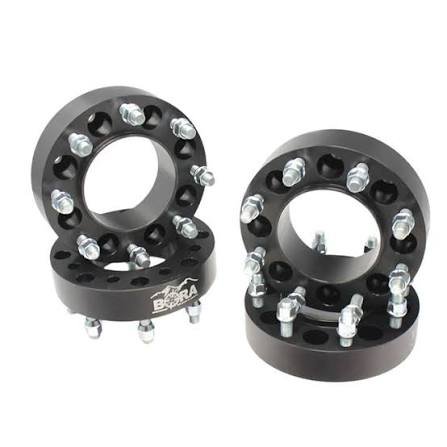
Bora 1.5″ Wheel Spacers | 80mm Bolt Pattern Adapters
Our Bora 1.5 inch wheel spacers deliver the aggressive stance you want with the safety precision-machined components demand. Engineered for vehicles running an 80mm bolt pattern, these spacers push your wheels outward 38.1mm (1.5 inches) for improved track width and tire clearance.
We machine every spacer from 6061-T6 aerospace-grade aluminum billet, then apply a corrosion-resistant anodized finish. Each kit includes Grade 10.9 heat-treated studs that exceed OEM strength specifications. Our proprietary hub-centric ring design eliminates vibration by maintaining perfect centering on your vehicle’s hub.
Whether you’re fitting wider tires, clearing upgraded brake calipers, or dialing in suspension geometry, these spacers maintain factory wheel balance while expanding your build options. Every Bora spacer meets ISO 9001 manufacturing standards and ships with our limited lifetime structural warranty.
- 1.5 inch (38.1mm) spacer thickness for 80mm bolt circle diameter applications
- 6061-T6 aerospace aluminum billet construction with Type III hard anodizing
- Hub-centric design maintains OEM wheel balance and eliminates vibration
- Grade 10.9 heat-treated extended studs pre-installed and torqued to spec
- Fits 4-lug, 5-lug, and 6-lug patterns with 80mm PCD measurement
Materials & manufacturing process
We start with certified 6061-T6 aluminum billet—the same aerospace-grade material used in aircraft structural components. This alloy offers an optimal balance of tensile strength (310 MPa minimum) and corrosion resistance that cast or forged alternatives can’t match.
Our CNC machining centers hold tolerances within ±0.02mm across all critical dimensions. Every spacer undergoes a multi-axis turning process that machines the hub bore, stud holes, and mating surfaces in a single setup. This eliminates the cumulative error you get with multi-operation manufacturing.
Hub-centric design & vibration elimination
Why hub-centric matters
Lug-centric spacers rely solely on wheel studs to center your wheel—a design that creates micro-movement and vibration at highway speeds. Our hub-centric engineering uses a precision-machined pilot ring that registers directly on your vehicle’s hub.
The pilot bore matches your OEM hub diameter within 0.05mm. When you slide the spacer onto the hub, it centers automatically before you even install the wheel. This prevents the wheel load from transferring through the studs during cornering and braking.
Bolt pattern compatibility & PCD verification
The 80mm specification refers to the bolt circle diameter (PCD)—the diameter of the imaginary circle that passes through the center of all lug holes. For an 80mm PCD, this measurement equals exactly 80 millimeters.
Measuring your vehicle’s PCD
Four-lug patterns: Measure center-to-center distance between opposite studs. Five-lug patterns: Measure from the center of one stud to the far edge of the stud two positions away, then multiply by 0.588. Six-lug patterns: Measure center-to-center distance between opposite studs.
More Bora wheel spacers by bolt pattern & thickness


What people are saying

Common questions about Bora 1.5″ wheel spacers
Measure the bolt circle diameter (PCD) using a caliper or ruler. For 4-lug wheels, measure center-to-center between opposite studs—this should equal 80mm. For 5-lug patterns, measure from the center of one stud to the far edge of the stud two positions clockwise, then multiply by 0.588. If the result is 80mm (or very close), you have an 80mm PCD.
You can also check your vehicle’s owner manual or search online fitment databases using your year, make, and model. Common 80mm applications include certain Honda Civic models, Mazda MX-5 variants, and select vintage Japanese imports. Our technical team can verify fitment if you’re unsure.
When properly installed, our 1.5″ hub-centric spacers maintain OEM safety standards while widening your track. The increased track width can actually improve cornering stability by reducing body roll. However, you’re changing your vehicle’s scrub radius, which may make steering feel slightly heavier at low speeds.
We design our spacers to handle full vehicle loads including towing and performance driving. The 6061-T6 aluminum and Grade 10.9 studs exceed factory component strength. The critical factor is proper installation—following torque specifications and re-torque intervals ensures the clamping force remains constant. Thousands of customers run our spacers daily on street cars, track vehicles, and off-road builds without issues.
We strongly advise against stacking spacers. Each spacer adds another mating surface and additional stress points. If you need more than 1.5 inches of spacing, order our 2.0″ spacers instead—they’re engineered as a single component for that specific thickness.
Stacking also creates stud length issues. The extended studs included with our 1.5″ spacers are calculated for that exact thickness. Adding another spacer means the studs won’t engage enough threads in your lug nuts, creating a dangerous installation. Always choose the single spacer thickness closest to your target measurement.
Yes, re-torquing is critical. Torque all lug nuts to specification immediately after installation, then drive 50 miles and re-torque. The initial heat cycles cause microscopic settling in the mating surfaces—re-torquing ensures proper clamping force after this settling occurs.
After the 50-mile check, re-torque every 5,000 miles or during tire rotations. This takes five minutes and prevents the gradual loosening that occurs with any wheel installation. We include detailed re-torque procedures in every kit. Most wheel-related failures trace back to improper torque maintenance, not spacer quality.
Hub-centric spacers like ours use a precision pilot ring that registers on your vehicle’s hub, centering the spacer before you tighten any lug nuts. This design transfers cornering and braking loads through the hub—the same way your factory wheels attach.
Lug-centric spacers have oversized center bores and rely entirely on lug nuts for centering. This creates vibration because the wheel can shift slightly as you torque the lugs. The constant micro-movement fatigues studs and creates uneven tire wear. Hub-centric design eliminates these issues by maintaining perfect concentric alignment between hub, spacer, and wheel.
Yes, as long as your aftermarket wheels have an 80mm bolt pattern and the wheel’s center bore is large enough to clear the spacer’s outer pilot ring. Most aftermarket wheels use larger center bores than OEM to fit multiple vehicles, so clearance is rarely an issue.
Verify that your wheel’s lug seat type (conical, ball, or flat) matches your lug nuts. Our spacers work with all three seat types—you just need the correct lug nuts for your specific wheels. If your aftermarket wheels came with tuner-style lug nuts, continue using those. The spacer doesn’t change your lug nut requirements.
The 1.5″ spacers move each wheel outward 38.1mm (1.5 inches) from the hub. This translates to approximately 38mm of additional clearance between your tire sidewall and suspension components, though your exact gain depends on wheel offset and tire section width.
For example, if your wheel currently sits 10mm inside the fender, adding our 1.5″ spacers moves it 28mm outside the fender lip (38mm outward movement minus the original 10mm inset). Always test-fit with the suspension compressed and wheels turned to full lock before final installation. We recommend staying within 5-10mm of the fender for safety and tire protection.